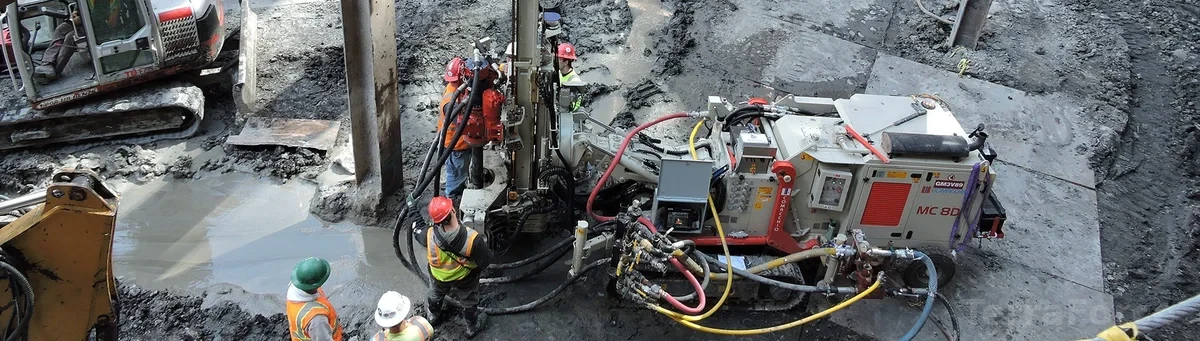
Curtain grouting is a critical geotechnical engineering technique employed to reduce the permeability of soil and rock formations, creating a continuous barrier against water seepage and groundwater flow. This work type involves the injection of specialized grout materials into the ground in a systematic pattern, typically along a line or plane, to improve ground conditions for deep foundation projects, dams, embankments, and other hydraulic structures. The process serves as an essential component of ground stabilization and water management strategies in areas where natural soil permeability poses risks to structural integrity, foundation stability, or project feasibility. Curtain grouting is particularly valuable in foundation engineering where controlling groundwater flow beneath pile caps, caissons, or raft foundations prevents uplift pressures, reduces settlement, and ensures long-term durability of deep foundation systems. The execution of curtain grouting projects requires comprehensive understanding of subsurface geology, hydrogeological conditions, and soil mechanics. Grouting operations typically follow established drilling grids, with injection holes spaced at intervals determined by soil investigation results, permeability testing, and design specifications. Common injection methods include stage grouting, where successive sections of boreholes receive grout applications at varying pressures and volumes, and dental grouting, which involves multiple passes to fill voids systematically. The selection of grout materials depends on ground conditions, target permeability reduction, and environmental considerations, ranging from cement-based slurries and clay-cement mixes to chemical grouts and polyurethane formulations. Engineers must carefully control injection pressure to avoid excessive ground heave, fracturing of weak strata, or unintended grout migration that could compromise nearby structures. Equipment selection for curtain grouting operations is critical to project success and efficiency. High-pressure grouting pumps, including piston pumps and screw pumps, deliver consistent flow rates and pressures necessary for deep injection into competent rock or dense soil formations. Drilling equipment must accommodate precise hole placement and depth control, with rotary drilling rigs or percussion equipment common depending on ground composition. Grout mixing plants ensure uniform material consistency, while flow meters, pressure gauges, and grout quality monitoring systems maintain compliance with project specifications and enable real-time adjustment of injection parameters. Support equipment includes compressors for air drilling and tremie pipes for placement in borehole sections. Curtain grouting finds extensive application across diverse construction contexts within the deep foundations sector. In dam and embankment construction, grout curtains reduce seepage beneath structure foundations, protecting against piping failures and hydraulic instability. Underground construction projects, including metro tunnels and basement excavations, employ curtain grouting to control groundwater inflow and stabilize weak zones ahead of excavation. Waterfront structures, bridge foundations, and retaining wall systems benefit from reduced permeability around critical foundation zones. Ground remediation beneath existing structures may employ curtain grouting to address settlement or water intrusion issues, demonstrating the technique's versatility in both new construction and rehabilitation applications. Success depends on thorough site investigation, appropriate method selection, competent equipment operation, and rigorous quality control monitoring throughout the injection process.