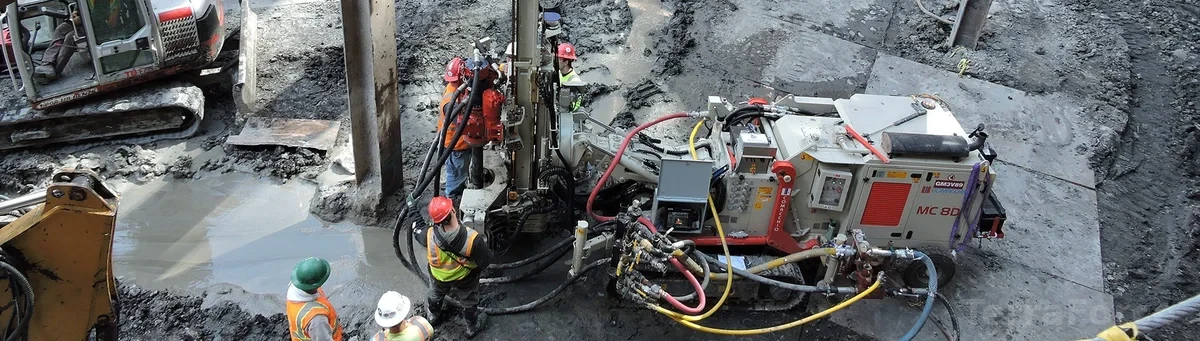
Compaction grouting is a specialized ground improvement technique that utilizes drilling rigs to inject high-viscosity grout mixtures into weak or loose soil strata beneath existing or planned foundations. This process, also known as compensation grouting or pressure grouting, involves drilling precisely positioned boreholes to predetermined depths where grout is injected under controlled pressure. The injected grout creates a bulging effect in the soil mass, densifying loose granular materials such as dense sand, gravel, and coarse-grained soils. Drilling rigs equipped with specialized injection systems are essential to this process, as they must achieve accurate hole placement, maintain consistent drilling parameters, and support the pressurization equipment necessary for effective grout delivery. The technique is particularly valuable in urban environments and densely built areas where traditional excavation and compaction methods are impractical or would create unacceptable disturbance to adjacent structures. The methodology of compaction grouting with drilling rigs involves a carefully coordinated sequence of drilling, pressure monitoring, and grout injection. Drilling rigs lower injection pipes to specific depths, creating access points within the soil profile for controlled grout placement. As grout is injected under pressure, it creates a sphere of compacted soil around the injection point, incrementally improving the bearing capacity and reducing settlement potential of the foundation layer. Technicians monitor injection pressure, flow rates, and ground response in real-time to ensure optimal soil densification while managing heave and minimizing impact on surrounding structures. This controlled injection approach differs from conventional grouting methods and requires drilling rigs with precise depth control, stability, and compatibility with pressurized injection systems. The grout composition, typically a stiff mortar of cement and sand, resists flow through soil voids, ensuring maximum compaction efficiency rather than permeation filling. Applications for compaction grouting with drilling rigs span diverse foundation engineering scenarios, including underpinning of existing structures, mitigation of liquefaction risk in seismically active regions, settlement reduction beneath sensitive buildings, and ground improvement prior to new construction in areas with variable soil quality. Engineering teams employ this technique to address subsidence caused by mining, organic soil consolidation, or inadequate original compaction. Drilling rigs allow precise targeting of weak zones at various depths, whether in loose sand layers, weathered rock, or unstable fill materials, making the method highly adaptable to complex subsurface conditions. The equipment's capability to access confined spaces, navigate around existing utilities, and maintain vertical and lateral accuracy makes specialized drilling rigs indispensable for compaction grouting operations in constrained urban and industrial sites. Industries relying on this ground improvement method include infrastructure development, bridge and tunnel construction, airport runway rehabilitation, and the reinforcement of historical structures requiring foundation strengthening without major excavation or displacement.
Get the latest equipment listings, industry news, and market insights.